
G. William Skinner Map Collection
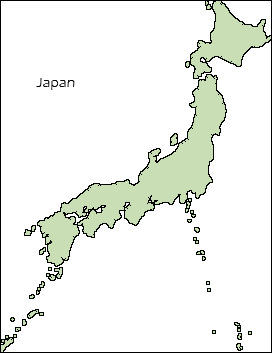
G. William Skinner (1925-2008) was the dean of sinological anthropology in the West, and a major theorist of family systems and of spatial social science. He was a pioneer in applying spatial analysis techniques to the study of agrarian societies, China, Japan, and France in particular. At his death in 2008 he left a collection of over 700 maps that he and his associates created at his Spatial Systems Laboratory at the University of California, Davis, as well as over 450 rare maps from other sources. The original maps are now part of the University of Washington Libraries Map Collection, and digital versions of these maps are available here.
Skinner's maps are products of his lifelong interest in the spatial distribution of social variables. He theorized that social structures vary along a continuum, which he called Hierarchical Regional Space (HRS). HRS was in turn defined by location relative to a central-place hierarchy, essentially a rural-urban continuum, and by location relative to a separate core-periphery structure, defined by natural physiographic endowments. He applied this theory first and foremost to agrarian China, which he decomposed into nine physiographic macroregions. Within each region he used a variety of demographic and socioeconomic data to define Hierarchical Regional Space. He also applied these concepts to Tokugawa Japan and to 19th century France.

The maps created by Professor Skinner have a great variety of themes, from the HRS classification itself, to such demographic and economic variables as the sex ratio, fertility, and agricultural wages. Skinner's work required the use of local historical sources. This collection includes original maps from 19th century Japanese villages and French departments, as well as detailed topographic maps used by the Japanese military in their invasion of China.
It also contains scanned images of paper maps created by Skinner and his associates. Most portray China, Japan, or France, and are large in size. Many have themes that reference Skinner’s own conceptions, including China’s physiographic macroregions, Hierarchical Regional Space, and related indexes.
About the Database
Combining large-scale scanning techniques, ContentDM JPEG 2000 software, and scholarly research on each map's creation and context, this database allows researchers to access color digital images of all 1200 maps from the Skinner Collection. Use the sidebar links at right to view the maps.